Stock code
839391
Monolithic vs Shaped Refractories: Where Each Wins and When to Combine Them
Release time:
2026-10-15
Author:
Source:
The choice between monolithic and shaped refractories comes down to four things: service area, wear mechanism, installation method, and maintenance plan. Pick by zone, not by ideology — and you will almost always end up with a hybrid lining rather than one or the other across the whole furnace.
This guide walks through how each format develops its structure, where each performs best in ironmaking and steelmaking, which installation risks decide the real-world outcome, and how to read a lining proposal through a total-lifecycle-cost lens rather than a price-per-tonne one.
Monolithic Refractories and Shaped Refractories: The Fundamental Difference
A shaped refractory — brick, precast block, nozzle, slide gate plate — leaves the factory as a finished product. The manufacturer fires it, inspects it, and ships it ready to lay. A monolithic refractory arrives on site as raw material: a bag of aggregate and binder that only becomes a lining when your team mixes, places, cures, and heats it.
The implication is not about which is "better." It is about where you want the quality control to happen — in a controlled factory or in the field.
How Monolithic Refractories Develop Their Structure
Monolithic materials fall into three families, each with a different setting mechanism:
- Castables (castable refractories) — hydraulic-setting, mixed with water, poured or pumped into formwork, vibrated to settle.
- Ramming mixes — dry or semi-dry, compacted by hammer or vibration, no water during placement.
- Gunning mixes — shot through a nozzle with compressed air, typically used for hot repairs.
Their structure forms from the bottom up: particle packing gives bulk density, binder chemistry gives green strength, and heat-up gives the final ceramic bond. Get any one of these wrong and the material that passed the lab test will not perform the same way in your furnace.

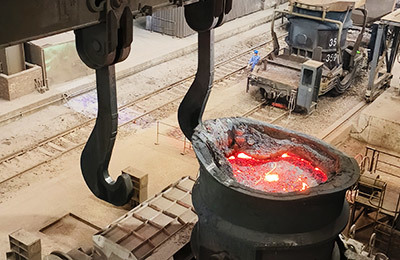
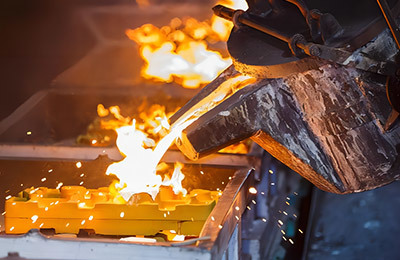
Fig.1 — Monolithic castable being poured into a steel ladle lining
Where Shaped Linings Complement Monolithic Refractories
Shaped products hold their value in four situations:
- Dimensionally critical zones — slide gates, nozzles, and pouring ports where tolerances are measured in millimetres.
- Factory-fired quality — where the buyer cannot reliably cure or dry-out a castable on site.
- Predictable installation — bricklaying crews are available and weather conditions are controlled.
- Thin, high-alumina zones — where the installed cost of a shaped product is actually lower than a thick monolithic layer that must be vibrated, cured, and slowly dried.
In practice, most linings run a combination: monolithic in the working zones that see frequent wear, shaped in the permanent layers and functional components that must hold geometry.
Performance Advantages
The performance comparison is not "castable versus brick" — it is "lab-measured values versus field-measured values."
Shaped products usually carry higher and more consistent lab numbers, because the factory controls firing temperature, holding time, and cooling. A castable that matches brick on paper may underperform on site if installation quality slips.
Lab Values Versus Field Performance
The critical control points for monolithic systems are installation quality — water content, mixing sequence, consolidation, curing time, and dry-out each determine whether lab performance translates to the field. A castable mixed with too much water will show lower porosity on a lab sample but will spall during first heat-up in the kiln.
What Gets Tested
Standard test packages for monolithic and shaped products cover:
- Chemical composition (XRF / wet chemistry)
- Particle size distribution
- Apparent porosity and bulk density
- Permanent linear change (PLC) after firing
- Cold crushing strength (CCS)
- Refractoriness under load (RUL)
- Hot modulus of rupture (HMOR)
- Thermal shock resistance (TSR)
These tests tell you how a material should behave. The field records tell you how it did behave. Both are needed before a lining decision.
Application Differences for Monolithic Refractories in Ironmaking
In the blast furnace ecosystem, monolithic materials dominate the trough systems (main trough, runner, skimmer) and the hot-blast stove checkerwork upper zones.
Why Castables Win in Trough Systems
Hot metal troughs see continuous flow, cyclic thermal shock, and chemical attack from slag and iron. A monolithic lining lets the operator:
- Replace a worn section in a single campaign without stripping the whole trough.
- Patch hot during the campaign using gunning mixes — no shutdown required.
- Match local chemistry to local wear — a higher Al₂O₃ castable in the spout, a silicon-carbide castable in the skimmer.

Fig.2 — Blast furnace main trough lined with alumina-carbon castable
Where Brick Still Leads in Ironmaking
The blast furnace stack and bosh still run almost entirely on shaped products (high-alumina brick, silicon carbide brick, corundum brick). The reasons are geometric precision, predictable installation sequence, and the ability to pre-plan replacement campaigns. Monolithic materials appear here only in the tuyere blowpipe linings and occasional hot repair.
Application Differences for Monolithic Refractories in Steelmaking
In steelmaking, the split is even sharper: ladles, tundishes, and AOD vessels mix both formats; EAF roofs and electric furnace deltaports are almost entirely monolithic.
Monolithic-Heavy Zones
- Ladle working lining — magnesia-carbon castables dominate, with monolithic repair replacing brick rebuilds on most programmes.
- Tundish permanent and working layers — monolithic throughout, because the tundish sees frequent campaign changes.
- AOD and VOD vessels — monolithic magnesia or dolomite systems, replaced campaign by campaign.
- EAF deltaports and roofs — gunning mixes, hot-repaired in service.
Shaped-Heavy Zones
- Ladle shrouds, nozzles, slide gates — factory-made alumina-carbon bricks or precast shapes, where geometry cannot be compromised.
- Permeable plug seats — shaped brick with a controlled porous core, never a castable.
- RH snorkel liners (in some designs) — high-alumina precast blocks for dimensional accuracy under vacuum cycling.
When requesting a quotation, ask the supplier for a zone drawing that separates the working layer, permanent layer, insulation, and functional components — this prevents the quote from pricing a single material across zones that need different solutions.
Installation Risks When Using Monolithic Refractories or Shapes
The single biggest risk with monolithic materials is installation quality. A brick with a 10 % strength gap between factory batches still performs predictably. A castable mixed with 1 % too much water can lose 30 % of its strength and show no visible difference until the first thermal cycle.
Mix and Placement
Water content must follow the manufacturer's specification — not the installer's preference. Mixing time, mixer type, and ambient temperature all affect the final structure. Placement vibration must settle the material without segregating the aggregate from the fines.
Dry-out and Heat-up
During dry-out, the lining must release moisture without internal vapour pressure building to the point where it cracks or spalls. As a rule of thumb, keep the heating rate below 15–20 °C/h through the 100–300 °C plateau where most free water leaves — faster than this and spalling becomes likely regardless of material quality.
Brick Installation Quality
Brick linings carry their own risks: mortar thickness variation, uncontrolled expansion joints, and poor bonding between courses. A monolithic lining hides these risks behind the formwork; a brick lining exposes them if the installer is not experienced.

Fig.3 — Refractory brick installation in a circular kiln
Selecting Monolithic Refractories for Lifecycle Value
The question is never "which material costs less per tonne." It is "which option gives the lowest total cost over the campaign life."
Reading a Total Lifecycle Cost
A total lifecycle cost compares:
- Material cost per tonne installed
- Installation labour and equipment (vibrators, mixers, pumps for castables; scaffolding and bricklaying gangs for brick)
- Dry-out and heat-up time — every extra day offline has an opportunity cost
- Campaign length (heats, tonnes of steel, operating months)
- Maintenance cost during the campaign (hot repair, gunning, patching)
- Downtime cost of a full relining
A monolithic lining that is cheaper per tonne but needs a two-day dry-out may cost more than a brick lining that can be heated in eight hours.
Starting From a Zone Map
Start with a zone map of your furnace or ladle. For each zone, record: temperature range, atmosphere (oxidising / reducing / neutral), mechanical wear type, chemical attack type, expected campaign length, and hot-repair access. This map is the real decision document — not the price list.
Asking the Right Questions
Good questions for a supplier proposal:
1. What is the reference case for this grade — which furnace, which zone, what campaign length?
2. What is the recommended installation method and who supervises it?
3. What dry-out curve do you specify, and what happens if we deviate?
4. What inspection data do you expect us to collect, and what do you do with it?
From Campaign Data to Better Grades
Suppliers refine grades and maintenance intervals based on inspection data and campaign feedback. One steelmaker reduced ladle reline frequency from 180 to 240 heats by moving from a single-grade lining to a zoned castable/brick hybrid — the change was guided by post-campaign inspection data.
That feedback loop, not the price list, is where real savings come from.
Key Takeaways
- Monolithic linings win where geometry is irregular, hot repair is frequent, or installation access is tight.
- Shaped products win where dimensional stability, factory QC, and predictable installation are priorities.
- Most real-world linings combine both — choose format by zone, not by furnace.
- Decision should be based on total lifecycle cost (materials + install + downtime + relining), not price per tonne.
- Installation quality is the single biggest variable for monolithic materials — a good castable badly installed outperforms a poor brick every time.
Need Help Choosing?
Send us a zone drawing of your furnace, ladle, or trough system. Within five working days we will come back with:
- A lining proposal showing which zones run monolithic, which run shaped, and why.
- Installation guidance including mix specifications, dry-out curves, and supervision options.
- A lifecycle cost estimate so you can compare options on a like-for-like basis.
Contact: WhatsApp +86 197 1280 6180 · Email zhangxin@jzjxht.com · Web www.jzjhxc.com
FAQ
Q: Can monolithic refractories replace all shaped bricks?
A: No. Three zones almost always need shaped products: slide gate plates and nozzles (tolerances under 1 mm), permeable plug seats (controlled porous core), and RH snorkel liners in some designs (vacuum cycling + geometry). Everywhere else — ladles, tundishes, troughs, EAF roofs — monolithic materials cover the job, often in combination with shaped permanent layers.
Q: Are monolithic refractories always cheaper than brick?
A: Per tonne, often 15–30 % cheaper — but that is not the comparison that matters. Total cost depends on installation labour, dry-out time, equipment rental, first-heat downtime, and campaign length. A monolithic lining with a two-day dry-out can cost more than a brick lining that heats up in eight hours.
Q: How do I decide between monolithic and shaped for a new furnace lining?
A: Build a zone map first. For each zone record: temperature range, atmosphere, wear type (thermal shock / chemical / mechanical), campaign length, and hot-repair access. Zones with frequent hot repair and irregular geometry favour monolithic. Zones needing millimetre tolerances and factory-fired QC favour shaped.
Q: Can monolithic materials repair an existing brick lining?
A: Only if the retained brickwork is structurally sound — check that there are no loose bricks, wear has not gone more than 30 % through the layer, and the repair mix has compatible thermal expansion with the existing brick. A site trial of 2–3 m² is the minimum before committing to a full campaign.
Q: What installation mistakes cause the most failures with monolithic refractories?
A: Five issues account for most field failures: (1) adding extra water to "improve workability" (kills strength); (2) insufficient mixing time (poor particle packing); (3) skipping or shortening the dry-out schedule (steam spalling); (4) installing at the wrong ambient temperature (binder does not set correctly); (5) vibration that is too aggressive (segregates aggregate from fines).
Related Blog
2026-09-23
Contact Us
WhatsApp : +86 19143919677
Mobile / Wechat: +86 19143919677
E-mail: biting@jzjxht.com
Address: No. 688, Guangxing Road Boai County, Jiaozuo City, Henan Province
Copyright © Jiaozuo Jinxin Hengtuo Advanced Material Co., Ltd.
Powered by :www.300.cn Supported IPV6 Privacy Agreement